Pages

Sunday, 26 August 2012

It rains in Thamuang as it rains in Diggle

Yesterday a picture of the weather in Diggle was posted on Facebook.  At the same time there was some banter about the thunder and lightening and how it could be an interesting ride for the man on top of the Saddleworth Rushcart.  (The Rushcart is an annual celebration held in Saddleworth by various groups of Morris men).  Another washed out Bank Holiday weekend.

Diggle August 2012
You might think that I am enjoying good weather in Thailand - well it isn't cold, but isn't all sunshine either:
Looking out of the front door yesterday morning

Caught out by a flash flood

Threatening sunset tonight

Thursday, 23 August 2012

Two villages Two bridges

This is blog post about how two different villages go about fixing bridges.  I hope to be very impartial (difficult) and therefore leave you to make up your own mind on the issues.

Diggle
A small village in Saddleworth, northern England between Oldham and Huddersfield.  The village lies in a valley with abundant small water courses, including a canal.  It is not known as flood zone, despite an average annual rainfall of (approx) 47 inches because the water courses effectively carry the water quickly downstream to the River Tame.  However, to those who are blessed with a keen eye, you cannot mistake that on three sides of the village there are steep hills, with Huddersfield Road (to the north) being the most obvious as it exits the village.  Needless to say, flowing down the road is a fair proportion of the annual rainfall with Thorns Clough, the little tributary to Diggle Brook running parallel about 50 feet below in the valley base.
More or less at the bottom of Huddersfield Road (north) is Carr Lane.  This is a steep road linking the northern end of the village to A670.  It is short but steep, probably classed as a single track road and at its lowest point there is a bridge.  Thorns Clough runs under the bridge and at it widest I would say it is three metres, in full flow.
It took the best part of a year and half to rebuild this bridge!  Well, I said I would impartial, OK the walls and banking along the road have been reinforced, which was a considerable job and as modern dry stone wall examples go, I would say cannot be bettered, but all the while the bridge was under repair as well.
A fine piece of civil engineering
Even when the project was completed there was a temporary closure as a good deal of the annual rainfall fell in 24 hours and cascaded, as it has done for centuries, down Huddersfield Road.  As we know from school physics, water is susceptible to gravity, and in this case there was a convenient right turn down Carr Lane to the bridge.  The result was that half Carr Lane disappeared and ended in Thorn Clough.  The bridge was fine, but Carr Lane was a mess.
A well engineered bridge to last until the next millenium
Disaster as the first flood washes the road away

If you are so inclined you can read more about the saga by following the link www.diggle-news.com/wp Photo above courtesy of Stuart Coleman - Diggle News

Now we move on:

Thamuang
A small village about 40 kilometres north of Ubon Ratchathani, north east Thailand, about 6 kilometres from Highway 2050.  The village lies on the flood plain on the River Sa, which eventually reaches the world famous River Mekong in about 50 kilometres.  There is a not a hill of any significance anywhere.  There is substantial annual rainfall of 60 inches (approx) most of which (55 inches) falls during the rainy season between May and September.  The problem arises when the river overflows.  The land is so flat, the floods rise without warning.  
The villagers have built houses on stilts to prevent flood water ruining their homes, or, as we have done, to raise the building land a couple of metres above the flood level.  
The main road into the village has to cross a small tributary that flows into the River Sa.  Without the bridge the diversion to the main road is about 20 miles (which is a long time on a Honda Wave motorbike).  The bridge finally succumbed and had to be replaced in August 2010 - the height of the monsoon rainfall.
The workman took about 4 weeks to replace it, and each and every one was a hero.  As I passed the temporary crossing, when it was available, they all waved a shouted out my name, a very friendly hard working bunch.
Construction of the bridge in flood conditions

A Just Do It attitude 

OK the water is warmer - but there's more of it

Temporary spans in place

Next day - more flood water

Serious construction work

The finished bridge

The finished bridge (Take 2)

As I have said, I want to be impartial in contrasting the two projects.  Therefore, I have summarised the prevailing conditions of both locations, the needs of each village and shown you how each working group performed and to some extent the results of their efforts.  

However, I must say the Thais have shown Oldham Council how to build bridges!  I received an email on 3 September 2012 stating the road and bridge are closed again for repairs - this is almost TWO years after the project started.


Tuesday, 21 August 2012

Jet Wash Day 2 and other musings

The Thailand sun is fierce today and by 9am I am already burning through my makeshift head gear sun protection.  Khamma has gone to the weekly market, which is held in the temple grounds.  On her return she announces there is a fine crop of mushrooms in the forest near where we saw the monkey last year.  This funny for two reasons: Khamma has never failed to impress me with her enthusiasm to pick wild mushrooms (she can spot a spore from fifty paces) and how the monkey sighting has become a point of reference, rather like we direct someone in England by reference to the pub.
Khamma's absence is soon forgotten in blistering heat and copious lashings of factor 15, which soon runs off in river-lets of sweat dripping into my already sodden shirt, once witness to so many corporate meetings in my former life.  My mind wanders again as the slime and dirt coagulating on the paths and wall over the past four years is stripped off in regimental patterns and washed away into the rice fields, where it belongs.
Khamma returns a little less enthusiastic than when she left.  The crop was not as big as rumoured, or she arrived too late, I think the latter because she says she is going tomorrow at dawn.  I smiled as she washed off the dirt in a bucket once used to mix cement - this is Khamma.
The Bosch jet wash and I are working as a team and the yard looks much better - even the neighbours and locals are commenting.  At close of play there is just the garden area to finish off tomorrow.  It is going to be a long job, but it should last for 10 years if the paint does what it says on the can!
As the sun began to sink over the lemon trees, I decided to go and visit Billy in the next village; any excuse for a well earned beer.
Just before tea Khamma and I sat outside and counted seven bats leave the loft like fighter jets leaving an air craft carrier.  She then informed me how she had found a dead snake in the loft after last year's floods.  Comforting pre-dinner chit chat, or what?  This goes with the two frogs and a mouse I have already found in the living room since Saturday.  Thailand no place for the faint hearted.

Rural Thailand Jet Wash Warrior in full combat gear

Monday, 20 August 2012

Jet Washing the Yard

There is some kind of mental relaxation in jet washing the yard.  It is, in a way, similar to mowing the lawn except the result is more satisfying.  Perhaps it is destructive and creative at the same time.  I don't know the answer, but today I have spent six hours in my own little world creating a new look for the yard that had started to become overgrown with a silty deposit created by dust, wind, sun and rain over the last couple of years.  I must say it looks good, and it has occupied me as well.
We bought the jet wash from Ubon Watsado (similar to B&Q).  It is an Aladdin's cave of stuff from taps to guitars, paper clips to wool.  It also employs most of Ubon's youth who do their very best to assist, but almost always confuse.  In the jet wash department there is proud display of several models to choose from. I selected the mid range Bosch model and wanted to inspect it for all its parts before going to the check out counter.  Company rules apparently forbid the customer from doing this, even though the box was open.  OK, you cannot beat the system so I reluctantly 'gave in'.  Needless to say at the check out I was so pre-occupied with the payment process (well it is Thailand, so I need some slack) I forgot to check.
I carried the box on my knee sitting on the back of the motorbike all the way back to Owerrrouse, only to find half of it missing.  This was a reminder of the frustration called Thailand.

Next day we hired Khamma's nephew to drive us back to Ubon to exchange the goods.  Whilst we were there we bought  paint, brushes, light bulbs, pens, a new headset for the computer and, one the way out of the car park, a bookcase!  On the way home, we stopped for petrol, called in Tesco Lotus Express and a roadside butchers where biggest blow fly I had ever seen was having a whale of time on the fresh flesh.

Eventually we got home and Khamma made Sunday lunch for ten!  We sat on the floor in the kitchen with a traditional Thai meal.  Half way through Khamma's sister called from France and we joined in a mobile Skype conversation.  A fusion of traditional habits and modern technology.  Amazing.  

After lunch I assembled the jet wash and made a start on the yard.  As the sun set I realised the investment in the jet wash was not only improving Owerrouse, it was therapeutic, and I couldn't wait for tomorrow to start work.

There was not a square inch of yard untouched by my trusty jet wash by the time I finished.  I was looking forward to a well earned beer and decided to visit Billy in the next village.  But just as I was setting off, Adrian passed by on his way for a beer with Mike, and my plans changed.  This is Thailand.

Back in Thamuang

The start of a 5 week break in Owerrrouse in Thamuang.  I have been looking forward to this for a long time as it over 12 months since I was last here.  The effort I have put into my business venture over the two years has been immense and I deserve a holiday.  I am really enjoying working for myself.  The freedom from corporate rules, regulations and politics is good and my clients are great.  I am certain that there some sceptics back in the 'corporate world' that doubted I could make a reasonable living out of writing Wills.  It has been hard work because when you do not know what is going to work out, you follow every single idea that pops into the head.  As luck has it, some of them worked, and a lot didn't.  Anyway, I might not be ordering a new Ferrari but at least I can join Green Flag to rescue me if the trusty Renault breaks down.
Khamma spent 6 wonderful months in Diggle over the winter, but returned to Thamuang in early May to start this year's crops and take over another 3 acres from her mother.  That's a lot of rice to nurture, but it needs rain to make it viable.  Every farmer in the world has two pet complaints: not enough rain, or too much!  Last year there was so much rain Khamma was filling sand bags to stop the floods coming into the front room, but this year there is not enough and you can hear the rice is crying from dehydration.  With all the rain we had in England this summer, it seemed like we should swap weather systems.  The surest way to achieve this is for me to go to Thamuang and take the rain with me.  This was a success and in the first 24 hours in Thamuang it has hardly stopped.  In a way I want it to continue as you can almost hear the rice grown and burp as it sucks up the moisture, but on the other hand I have enough of rain in England and could do with sunshine.
It is good to be here though.  I slept for 14 hours last night - sheer tiredness from the rush to finish off work for my clients and the journey via Doha to Bangkok en route to Thamuang.
Owerrrouse is really great and Khamma keeps it so clean.  It is 4 years since it was built, and looks as good now as it did then 

Over the next 6 weeks we plan to re paint outside and inside.  You might ask why don't we get somebody to do this for us.  The fact is that 'somebody' (ie your typical Thai local looking out for a quick bhat or three) does not know how to paint.  You can expect everything to be slopped on with more paint landing on areas where it shouldn't and most of it on the face of the Thai labourer who is convinced they know what they are doing.  No this is a job for me, at least supervising (controlling?) the labour force.

After that is air con, or maybe a new motor bike.  Now that Yo is at senior school in Ubon and sharing digs with Pell there is a huge demand on the only road worthy motorbike.  The other one is a clapped out Honda that was serviced in the last century.  It has a braking distance of 3 miles at 15 miles per hour.  Not good for touring round NE Thailand.  Wait and see on this one - Air Con or Motorbike - what would you do?

Pell had a 'nose job' last week.  In her never ending quest to change her already beautiful Thai features into something more 'European', she went ahead to have a bit of filler injected to change from a cute nose to a well 'cute nose'.  I'm not sure I can tell the difference.  It never fails to amuse me how Asian girls aspire to white Caucasian looks, whilst Caucasian girls aspire to tans to die for.  Pell and Khamma are not exceptions despite my constant 'yakking' for them to be as natural as they are already.

I hope you join me over the next six weeks for the latest in Life in Asia and Thamuang.

Friday, 28 October 2011

A day in the Life of Ban Sam Yord

The village of Ban Sam Yord belongs to more than two hundred Hmong people.  My first view of the village was a rather disappointing blue tin roof, much like the one on Khamma's kitchen Thai in Thamuang.


The scene quickly changed into a scene of huts scattered on the hill side with chickens, ducks, pigs, cows and goats wandering around.  

There was a lot noisy activity taking place in the centre of the village, coming mainly from the men folk who were constructing a small building in which to store rice. They were using machetes, crude saws and a hammer and nails; as we say in the north of England 'rack of th'eye and rule o'thumb'.  As usual, there were more watching than working!  In between this centre of attraction, many children were running around playing games or just being inquisitive towards the new strange arrivals.


The Tourist Department constructed the hut we stayed in especially for visits like ours.  It was quite spacious with a room for sleeping and a kitchen.  The floor was hard packed dirt but it was cool and cosy.  After claiming a sleeping place on the raised platform that was the bed, we ventured round the village to see what was going on.  


We called in a home where four generations lived; the eldest was grandma at a good 78 years old. We saw children playing a game with spinning tops and watched the animals living cheek by jowl.  


By the time we arrived at the rice store, the men had stopped and were viewing us quizzically.  They were smoking from a water pipe and Mark and Til could not resist having a go.  By their reaction and their antics for the next thirty minutes, there was no doubt that the smoking mixture was a bit whacky.


Our guide, Somphone, asked what we would like for evening meal.  We had a choice of goat, duck, chicken or pork.  We settled for pork and Somphone promptly identified a succulent specimen in the yard.  A man from the house next door caught it and trussed it up.  It was small, but it could kick and squeal like an animal ten times its size.  First, the front legs were tied together, then the back legs and a small log passed from front to back.  It made enough noise but was bound in such a way it could not move.  Just outside the hut was a water well, which was the main supply for drinking, washing and cooking.  There was also a square frame, and the log, complete with trussed pig, was placed in the frame at about waist height.  The pig’s head was at the side of the frame and because it was upside-down, the underside of its neck was exposed.  Somphone placed a bowl under its head and, at that precise moment, out of nowhere, another man appeared with a knife and slit its throat.  Warm blood poured into the bowl as Somphone stirred it with his hand to prevent it from congealing.  The pig was jerking and writhing until all life had expired and it became meat rather than an animal.

Once the flow of blood had stopped, the pig was untied from its bondage and the job of scrapping the hair from its skin began.  Boiling water was poured over the skin and using a spoon suspiciously similar to the one we used earlier in the day at lunchtime, its hairs were 'shaved' away.
It took sometime to de-hair the pig, but once finished the anatomy lesson began as Somphone opened up the pig to reveal its insides.  Everything was carefully extracted out of the animal, including ears and trotters, and eventually we started to recognise pig meat.


It was a strange experience.  It is no use taking moral high ground.  This is the way of village life in a remote forest in northern Laos.  It is different culture and it was my privilege to learn from their way of life (or death if you prefer).


Activity switched to the kitchen as the cooking pots boiled over charcoal fires and Somphone took control.  We chatted amongst ourselves and in the common ground of a Laotian forest, we exchanged stories of background and travels.  I think our German friends were quite impressed with the catalogue of expeditions and travels Dave and I had notched up.  It never ceases to amaze me even if I say it to myself!


After the culinary theatre of the preparing and cooking the pig, the actual meal itself was not exciting.  I had a feeling the best meat ended up on somebody else's plate in the next hut.  What little we had was tasteless and smelt of steamy abattoirs.  The pumpkin soup was good as were the vegetables and spicy sauce.  Sticky rice does nothing but give the illusion to the stomach that it is full, and if you eat too much, it bungs you up for days. However, Somphone's work was appreciated and he was the perfect host.

There was no pub to go to, so we settled down and listened to the noise of village.

I awoke at some stage to hear a very faint chanting coming from a hut that I thought was behind us.  It was a rhythmic repetitive chant with about four voices.  Interspersed I could hear distressed cries of someone in obvious pain.  Then it stopped.  Next morning I learnt that someone had been very ill in a hut about 100 metres away and the shaman tried his best to save her life, but she died.

Trekking in the Nam Ha National Conservation Area

We spent the next couple of days on buses travelling to Luang NamTha, which is a small town very close to where Laos borders with Burma and China.  This was once the Golden Triangle, infamous for cultivating opium and illegal drug activity.   The plan was to trek into the National Park and stay in a village or two with the locals.  Eco-tourism plays an important part of the economy and they welcome intrepid foreigners to join them on strenuous hikes through dense forest, up and down hillsides, through rivers and eat local produce with the villagers.  The sun is very hot at this time of year, which does not make it any easier.


The journey took a day and half.  It was interesting to see this part of Laos, which receives relatively few foreign travellers.  The countryside is spectacular and our fellow passengers were great fun.  Sat next to me was a 19 year youth from Vietnam whose English amounted to my Vietnamese.  He shared peanuts and other snacks and called me Witnala, another variation on my surname!  I never discovered his name or found out what he was doing.  


We sometimes walked as the bus drove through the mud.  The precarious position of housing made me wonder how they managed to keep from slipping into the water.  I would not be happy staying the night in some of them!


We arrived at Oudamaxi as the sun was sinking behind the dust clouds in the west.

Next morning we caught the mini bus for the 5 or 6 hour journey to Lumag Nam Tha.

Luang NamTha is a busy market town with a very busy bus station.  We stayed at the Bus Station Hotel, which was ok, but felt a bit grimy for its $4US per night.  There were some decent cafes and restaurants and even the internet was available (this was 2006 remember).  At one cafe, a couple of Akha women enquired in hushed tones if we were ok for ganja.  

We have never found a need for this so we did not even have to think twice about the warning posters from the Laos PDR Central Committee for Drug Control sponsored by the United Nations Narcotics Board of Control.  Instead, we opted for some fun haggling over local crafts.  We took a version of a Laos massage, which is supposed to knead out the knots, sooth the stiffness and bend out the bumps that accumulate following a week of relatively uncomfortable travel on river boats.  It was excruciating but the hot sauna brought back the blood to the body parts strangled by the sadists posing as masseurs. A great way to spend an afternoon for only 3$US.  


On the way back to the hotel I decided to have my hair cut after spotting a small barber shop.  It was not the best hair cut I have had but at 5,000 kip (30 pence), it was certainly the cheapest.


Trekking is organised by the Tourist Office and we were lucky that a trip was departing next morning exactly to the area with the stop-overs we wanted to experience.  It is very unwise to venture into the park without a guide because maps are unreliable and the tracks are constantly changing.  It is easy for a foreigner to get lost in the dense undergrowth, reading 'missing persons presumed lost' posters testified the warnings.  It is also a sobering thought that American bombing raids between 1964 and 1973 left Laos the most bombed country in the world.  We were aware that there is still a lot of unexploded ordinance, probably not so much in this region, but you do not get a second chance if you step on a land mine!  Over 260 million tons of bombs were dropped on Laos during the war; that's 210 million tons more than the combined total of bombs dropped on Iraq in 1991, 1999 and 2006, or a plane load of bombs dropped every eight minutes, 24 hours a day, for nine years.  Staggering!!!  (See www.legaciesofwar.org for more info)


We joined two other trekkers, Mark and Til, students from Bonn in Germany.  Our guide was Somphone and his young assistant was Mouaxeng (pronounced Mowasing).  After stopping at the market for fresh vegetables and sticky rice, we drove to a roadside village where the track up the hillside, through the rice fields and into the forest and beyond began.  It was baking hot in the noon day sun as the mad dogs and Englishmen zig zagged up the path.  


We were soon sweating, but thankfully, we had an early lunch and a leisurely break, which gave us the opportunity to get to know each other a little better. 
Onwards and mostly upwards, we trekked for about three hours before we reached the village Bam Sam Yard.  This is home to about 200 Hmong people and it did not take long to meet our hosts.


Sunday, 23 October 2011

Apocalypse Now country

The Nam Ou hotel was a ramshakle affair, taking on the air of a backpacker's hostel, without the 'hostel' bit if you see what I mean.  It was laid back and comfortable, almost, but not quite, an oasis from the chaos of the river bank. 
I awoke at 6.30 am to usual sounds of Laos village life, similar to the previous morning - listening out for cocks crowing, birds tweeting, the chatter of women against the 'pock, pock, pock' of mortar against pestle grinding chillis, mango and spices into aromatic sauces.  I hear children playing, babies crying, the odd motorbike and adults coughing.  Not just any old cough, but a male voice choir of hawking, retching, gobbing and spitting stringy strands of spit and goz in long glutinous lobs in the direction they happened to be looking into at the time. I cannot get used to the way Asian's clear their lungs in the mornings.

I did not have the gumption to work the shower, so I had a cat lick in cold water, packed my bag and presented myself for breakfast.  What a start to the day!

After a stroll through the town, picking our way through the mud and gobs of spit, we arrived at the pier in search of our boat for the final leg.  


We met a couple of student backpackers from Switzerland who informed us that the boatman wanted $20US each and that they could not afford that price.  When Dave and I enquired, the price was the same.  The students could not see the logic in charging the same price for more passengers, so they started to haggle.  Dave and I stood back and watched a skilled haggler perform a master-class in driving the price down to $12US each.  Very impressive.


Meanwhile, there was huge entertainment in watching the ferry boat cross over from the far bank.


The huge floating pontoon carried trucks and cars and was kept from floating downstream by a tug.


The current was deceptive and at one point it seemed likely that the float would escape, but the boatman knew every inch of the river and skilfully guided the platform onto the ramp just below where half the population of Muang Khua had gathered to witness.

The vehicles rolled off and relieved drivers continued on their way to China on road 2E.

Although the movie Apocalypse Now was based in Cambodia, about 600 kilometres south, my imagination often wandered with visions of 'Charlie' lurking on the banks ready to snipe at our vulnerable boat chugging upstream.

My day dreams were brought into sharp focus as we boarded our vessel.  Today we had the 'comfort' of being protected by a armed guard who took position, with his rifle, on the stern.  I convinced myself it was a hunting rifle, but all of a sudden the prospect of meeting Colonel Walter E. Kurtz seemed a little bit too real for my liking!

The river was becoming narrower and there were less signs of villages, fishermen and boats, but more bird life, especially kingfishers.  The boat was full and the seats were even harder than the previous two days.  


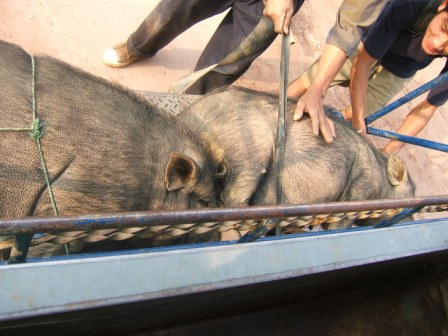
At one point we stopped and picked up three young men and six pigs.  Two of the pigs were small enough to put inside bamboo baskets, the two medium sized pigs were apparently trusted to sit quietly in the back, but the two big ones had to be trussed (presumably to stop them running all the home - wee wee wee wee!)

The pigs obviously objected and fought and squealed as their captors bound their legs together.  It did look distressing as they bundled them into the back, but this is the way of the world in these parts.


We arrived at our destination, Fong Sali, around 5pm.  We were about 25 kilometres east of the Chinese border, 25 kilometres west of Vietnam and about 40 kilometres south of the northern border with China.  It was very remote and a far cry from the 'hot spot' of Luang Phrabang.

As I disembarked, or rather unfolded my spasmed body from the near foetal position it had fossilised into, I managed to spike my hand on a rusty nail.  As I did so, my reaction caused me to do the splits over the side of boat, resulting in dragging my crotch and associated body parts on the rails.  I was not sure what hurt the most, but the bleeding hand needed attention.  Later I discovered the other area needed the attention of a Savlon antiseptic wipe as well!  

However, the immediate need was to negotiate a bus ride to the town to find a hotel.  Being older and wiser than our Swiss co-passengers, we left them to negotiate the price.  

There was a stand off as the driver smelt US $ in our pockets, but there were six locals who wanted to ride the bus as well.  It became obvious we were subsidising their fares and they would not be going until the price was agreed.  
Eventually the Swiss compromised, and although we had to share the back of the bus with the pigs, we were at last on our way.
As we climbed onto the back the bus, the pigs were tied onto the tailgate!  It had a bad day for the pigs, and tomorrow would be worse as various bits of them would be sold at the market.
We found a hotel in the town and after a meal with our Swiss bargain hunter friends, it was an early night to work out how to find a bus for the long journey south to Oudomxai.

Saturday, 22 October 2011

Day Two - A slow boat to China

Despite the early evening rain, there was hardly any rainfall during the night.  I woke to morning sounds of village life in Asia.  Random cries from the chickens. The occasional motorbike, crying children and the soft sweet singing of the women folk as they prepare food with fresh produce bought in the early morning markets.
I showered, even managed a shave in the cold water.  After breakfast we left the Many Poon and made our way back through the streets to find a boat for the next leg.  First the good news, the boat was running. Secondly the bad news, we were the only passengers and it would cost $60 US.  No choice.  We had to pay, but noted that suddenly the boat filled with local people and it was safe to assume they paid considerably less, or not at all.  Still, $30 each for a day on the river is a good price especially if it helps the local economy.  

We boarded the boat and I was intrigued that food preparation was carried out right next to boat.

The cargo that was loaded in the stern ranged from dvd players to pigs trussed up in bamboo baskets.  I cast my eyes over the passenger and counted twenty two people.  I noticed one girl with sharp cheek bones and stunning eyes.  She was in her twenties and was desperately trying to control her son, who I reckoned was a bout two years old.  She was losing the battle and judging by the look on her face, the will to live as well!  She hit him, but this made matters worse until the boy became exhausted and fell asleep.  Another young mother was feeding her baby and I realised that babies in Asia, especially in the villages, do not wear nappies.  How the mothers know when their baby is going to wee or poo I don't know.

As we set off under and chugged under the bridge, we entered some rapids, which for a moment made us realise that if this overloaded boat should tip over, we would make the world news.  After that early excitement, about ninety minutes later we suddenly stopped.  Dave and I had no idea what was going on, but most people got off the boat and sat on bank.  It gradually became apparent we had too much weight and the boat was taking in too much water.  Eventually a replacement boat arrived, but we couldn't work out how somebody knew to send one.  Mobile phones don't work and there was no village to run to.  It must have been by message on a boat returning downstream.


Everything was transferred, including the dvd and the pigs, and we set off again.  Dave and I found ourselves sat opposite five Akha ladies.  Follow this link for more information http://en.wikipedia.org/wiki/Akha_people

They kept staring at my hairy legs and again I realised that staring is a national pastime in Laos.  It is an inquisitive, thoughtful and silent stare, which neither gives indication that knowledge is being stored, or simply thinking that 'What on earth is this I am looking at, and I wonder where it comes from'.  I could not make eye contact with them and one of the ladies even kept her face covered nearly all the time she was on the boat.  I thought she had a cold, but she was probably embarrassed.


Throughout the  day, our fellow passengers departed and eventually we had the boat to ourselves.  Because of the unscheduled delay, we were travelling as dusk fell and it was touch and go if we have enough fuel.  Our best estimate of a five hour journey turned out to be nine hours bordering on epic.

We arrived in Muang Khua as darkness fell, and luckily for us the Nam Ou Hotel was only a few strides across the muddy banks of the river.  At $3 US a night, a supply of Beer Lao and tasty veg soup, it was even more convenient.

Into the Golden Triangle, northern Laos, by river boat


In September 2006, I visited Laos with Dave.  The plan was to travel as far north as possible on the Nam Ou from Louang Phabang, which is more or less in the centre of northern Laos. Once at our destination we planned to visit hill tribes before catching a bus back to Louang Phabang.  Sounds easy when you say read it like that.


Louang Phabang Mekong River
In Louang Phabang we stayed at a hotel called Lam Sok and explored he town's ancient temples and river banks.  The rain poured down all night and did not bode well for the river-boat trip.  In the morning there was no electricity therefore no shower.  However, after a hearty breakfast and with rucksacks packed we waited patiently for the boat and hopefully other passengers. We had heard that the boat does do not depart with less than five passengers, unless $80 is forthcoming from hard up travellers.  According to the 'timetable', or the word of mouth rumour, whichever you prefer, the boat departs at 8am.  By 9.30am there was still no sign of a boat, but our spirits had been lifted by the arrival of a Swiss couple who wanted to go on the same boat.  A short time later, it arrived with a fifth passenger and we were set to go on the adventure.  Had we misread the timetable, looked at an old one, or even the wrong one?
The Nam Ou (River Ou) flows into the Mekong river 25 kms north of Louang Phabang at a place called Pak Ou.  At this point there are caves on the west bank hoarding thousands of Buddha images, whilst on the opposite bank the village of Ban Xang Hai is famous for its whiskey made from fermented sticky rice.  Contrasting images characteristic of south east Asia.
The Nam Ou soon revealed its own character.  It is narrower than the Mekong and the high river banks revealed spectacular towers of limestone.  Sadly the sun was not shining, but sound of the boat's diesel engine chugging away and echoing off the rocks reminded me, once again, of my favourite movie Apocalypse Now!
The river was in full flow because of the monsoon rains, and it was fast flowing making our progress seem laboured as we made our way upstream.  The river is the life-line to the villages scattered along the banks.  Not only does it provide transport, but also food, irrigation and washing water.  The dense forests provide wood for housing and a small income from its sale to Europe and North America.  Back in Louang Phabang, I had noticed sacks of rice labelled with the United Nations food programme logo and wondered if they were destined for the ramshackled villages lining this beautiful river. 
Occasional rapids appeared and made our hearts beat faster as the prospect of sinking was a constant possibility.  If you feel unsafe on this journey, I advise you to take your own life vest! Brilliantly coloured birds, small and large, constantly darted across the river  looking for and sometimes diving for fish in the green water.  Their eyesight must have been at x-ray standard to see further than six inches in silty water.


There was no shortage of people, usually children, by the water's edge.  The women washing clothes, food or themselves and the children playing on mud slides, laughing, shouting and waving with joy as the boat passed by.  There wasn't a computer game in sight.  The menfolk, looking more serious were fishing, logging or tending the rice fields.  Always a stare sometimes a forced wave, but rarely a smile or expression of emotion.  More bewilderment at white men on a boat.   I had fleeting thoughts of Jerome K. Jerome but hoped for less comical eventualities.
The boat was about a metre wide and twelve metres long.  It had a low roof, which meant crouching and, as tall foreigners with hardly any flexibility in back or legs, we found awkward.  The wooden seats became extremely hard, and although the boatman had thoughtfully provided cushions, they did not contribute to the level of comfort.  There was little chance of stretching the legs, other than the infrequent stops whenever the boatman thought about it.


Our stopover for the night was the village of Nong Khiaw (I think Google maps refer to this town as Hat Sao).  Nong Khiaw, or Hat Sao if you prefer, is the first point at which a road bridge crosses the river.  This makes it easy to fine on the map.  Darkness was falling as the boatman waited patiently for a family to finish their ablutions.  We entered the village by  forcing our cramped limbs up the steep steps.  We both commented on the similarity to villages we had passed through in Nepal.  Tea houses lined muddy tracks where children, chickens and dogs ran excitedly in all directions saying hello and giggling when we replied in English.


We found a room at the Many Poon guesthouse for $4 per room, including mosquito net, but the bargain price meant we shared the shower and squat toilet with the owner and his family.
For those of you not familiar with Asian showering etiquette, you quickly learn that it is achieved by scooping cold water from a tank and pouring it over the body, lathering up the soap and rinsing off with addition scoops of water.  Not ideal, but it does the job.  The art of using a squat toilet is also learnt by necessity, and for some becomes a preferred modus operandi.  However, with dodgy knees and zero flexibility in my legs, I prefer the traditional design patented by Mr Thomas Crapper.
Dusk was falling as we walked over the bridge to the Sunset Guest House for supper and a welcome Beer Lao or two.  I had pumpkin and coconut soup followed by egg and vegetable fried rice.  Sadly the setting sun was absent from our lofty position on the terrace of the Sunset Guest House, and as the rain began to fall we ran back to Many Poon for a night cap and good night's sleep under mossie nets listening to night sounds of the forest, the occasional dog bark and the snoring of other guests through the paper thin walls.