Pages

Showing posts with label Thai politics. Show all posts

Monday, 4 July 2011

General Election in Thailand - Part 3 Voting Day in Thamuang

There are many special days in Thamuang, and the general voting day is about as special as it gets, except, of course His Majesty's birthday and various religious occasions. 
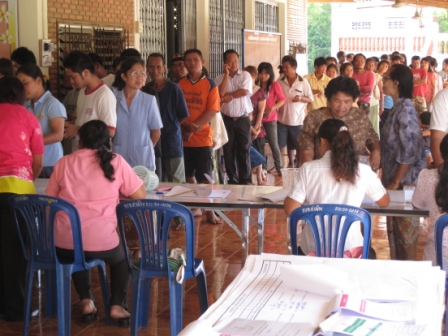
Khamma arrived at the temple just before 9am.  There was already a long queue of approximately fifty people waiting patiently and chattering jovially amongst themselves.
The temple acts as community centre or, in direct comparison to Diggle on these occasions, Wrigley Mill Methodist church.  There are no political party number collectors wearing anoraks and colourful rosettes, but a notice board where the electoral register is posted alongside details of every candidate.

The first thing to do is to take off your shoes because this is a building and it is customary to leave your shoes at the entrance.  This is similar to my house in Diggle.  So far, the comparison score is 1-1.
The first task is to identify yourself to the register clerk.  At this point, you have to produce an identity card, confirm your address and sign against your name.  A small observation occurs to me that the ID card in a country like Thailand, which is infamous for its disorganised bureaucracy, makes such prolific use of an ID card.  Where did the UK fail to make this work?
The clerk issues a ticket, which is handed to a second clerk who issues the first voting form.  The problem is that the queue for this clerk stretches back, at the time Khamma joined it, more than fifty people long.

ID card produced, name checked, signature, ticket issued - NEXT!
The queue stretches back to receive voting papers
It struck me that in the UK there would be protest about the length of the queue resulting in mild unrest and uneasiness amongst the electorate.  The scene in Thamuang was so different; the Thai people take the situation as it comes, without protest.  No doubt there was a rush as the polling opening because there is so much to do during the day - the rice fields are being planted, which in itself is a major task this time of year.
The second clerk allocated a ballot paper for the election of the main MP for the area.  The main difference was that the voter had to sign a receipt for his paper and show the ticket provided by the first clerk.
The voter then joined the queue for the third clerk who provided the voting paper for the election of the second MP, which is based on some proportional representation for the area.  I could not obtain a satisfactory explanation of how this works.  The voter has to sign the counterfoil and the clerk ceremoniously folds the paper before the voter enters the booth to enter their 'cross'.
It appeared chaotic, but there was order and process
Finally, the voter can now vote and make a difference to way the country is led for the next five years, or something like that.
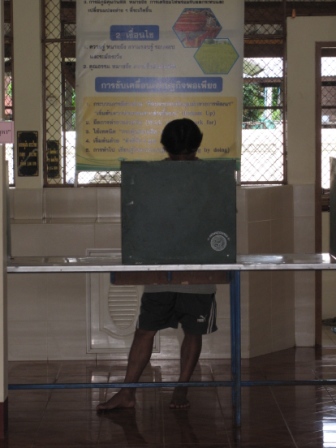
Finally, the vote is placed in the ballot box.

It was estimated that 75% of the village turned out to vote.  To me that is biggest difference between Thailand and the UK.  There appears to be a passion in Thailand to way the country is led.  It has been seen in the last five years - the airport closure, the city centre siege, the military coup - we might not approve of the way it is done, but these people care, they care a lot.  Many of them are poor, and cannot hope to escape the poverty, but they have a vote and they use it to try to speak out.  In my humble opinion, I do not think that is evident in the UK.
The red shirt party have won the election.  Thailand has its first lady PM, but she has a lot to do to prove her ability in government.  She will receive advice from her brother, but is it enough for Thailand to emerge from the shadow of recent violence.  We hope so.
Thank you to Thamuang for allowing me to use your pictures and trying to understand your politics.

General Election in Thailand - Part 2 The build up to voting

During the five years of post Thaksin politics there has been a pre-occupation of a battle for control of power.  There are so many interested parties: the 'red shirts' who are mainly the agricultural poor and pro Thaksin supporters, the 'yellow shirts' who are the middle classes and support anybody except Thaksin, the military who are supposed to be neutral but will state their position when they want to do so.  In addition, there is the powerful and respected influence of 83-year-old His Royal Highness the King of Thailand to consider.
The battle for control has led to the closure of Bangkok airport by the yellow shirts, the siege of the centre of Bangkok by the red shirts in which 90 people lost their lives and various skirmishes and postures between the antagonists.  Since the coup, the military have remained loyal to government.  However, they were instrumental in clearing the city of the red shirt siege in the city centre.  The King, who has served his country since 1950, is in poor health and denounces all violence.  His voice is powerful though and many Thai people look towards him for guidance.  He is a remarkable King, and we hope and pray for his health and long life.
After last year's siege, it was agreed that elections would take place in July 2011.  I arrived in Thailand ten days before polling day and the only evidence of an election I could see was several posters, identical except for the life size portrait of the candidate it was promoting and their election number, which appears on the voting form.  It was a massive difference from the expensive campaigning of American or British political battles.  There were several pick up trucks touring the towns and villages blaring out political messages, but it seemed the main rallying was reserved for the big cities, particularly Bangkok.
Sadly, I do not speak Thai so I could not find out what the main party messages are, but it does seem that in the latter stages, a smear campaign began on both sides.  No differences there then.
All I could establish was that Prime Minister Abhisit Vejjajiva's government had brought in improved roads and bridges to the village Thamuang where my wife lives.  This has significantly improved the village, and, perhaps helped them to decide which way to vote.
However, issues on the economy, education, transport, benefits and policing are insignificant to agricultural societies.  In these communities there is no money, transport is limited at best to a poorly maintained motor bike, there are zero benefits (no family income, no old age pension, no unemployment benefits) and policing is more or less left to the village leader (except major crimes like murder and drugs).  The people of the poor northeast would like consistency of the price of rice, compensation for flooding and greater medical facilities.  Unfortunately, I am not sure if the main parties engage in a national level discussion on these issues.
Nevertheless, there was a build up to the expectation of casting a vote, scheduled for Sunday 3 July 2011 between 8am and 3pm in the local temple.  This in itself is a big difference to the UK, where it is always a Thursday between 7am and 10pm.

General Election in Thailand - Part 1 Thaksin Shinawatra

In 2006 Thaksin Shinawatra was ousted as prime minister in a military coup.  I was in Bangkok at the time, but it was only when I returned to England a few days later that I heard the news.  Such is Thai politics that its understated drama completely underwhelms the population.
Thaksin is (was) a tycoon businessman who made his fortune in the growth of Thai telecommunications.  He started his political career by forming the Thai Rak Thai (Thai loves Thai) party in 1998 and quickly gained the support of the nation's agricultural poor by introducing improved medical care, debt relief and denouncing Thailand's upper classes from a nationalist platform. Thailand's economy improved with a style became known as Thaksinomics and after years in the doldrums the Thai economy began emerging. 
On the other hand his handling of the crack down on drugs in which 2,500 people are believed to have died and accusations of corruption in his government began created a new level of uneasiness and tension about his tactics. 
The sale of shares in the Thaksin family telecoms business lead to a snap election in 2006.  The sale proceeds were $1.9 billion, avoided taxation and passed a national asset to Singaporean control.  Some argue this was a shrewed business move, but politically it made many more enemies for Thaksin.
After the military gained control, Thaksin started his life in exile but his influence over Thai politics has not wained.  He faces prison in Thailand after being found guilty of corruption, but has found refuge in Dubai from where he regularly transmits live video links to political rallies held by his 'red shirt' supporters.
His support is now with the Pheu Thai party which is led by his 44 year old sister Yingluck Sinawatra. 
Yesterday she became Thailand's first female prime minister and the fifth since Thaksin was ousted in 2006.