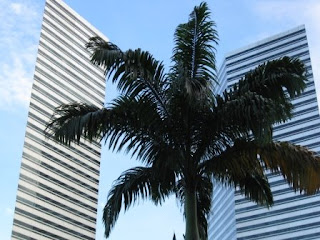
Imaginative design in Singapore
 The new Singapore Flyer
 The Singapore Cricket Club in the Central Business District

The old Singapore shophouse
Mr Theroux introduces Singapore as 'Little Tinky-Winky Singapore'. An image of Disney and sparkly glitter dropping out of the black equatorial night sky. But he really meant that the city was completely transformed and had a 'tinkered with look', nothing was the same, nothing familiar. The street names are the same but the streets are not in the same place. He sees Singapore as 'a single modernized piece of geography' where the island, city and rural areas are one and the same and its boundary marked by the muddy shores of the land reclamation.
Cities change constantly because that is what they are supposed to do. Manchester's transformation is remarkable, Hong Kong and Shanghai are further examples of cities evolving and adapting to reflect the status of their inhabitants. Many cities cannot make this change so easily because of the infrastructure they are built on, New York is a good example, and in these cases the changes are less obvious. This type of city will change from the inside by recognising they need to change the social infrastructure, the welfare of its people, it's transport policy. Cities that don't change lack colour and life and a good example to compare with Singapore is Toronto. Thirty five years ago Toronto was the Singapore of the west with a high immigrant population, lots of growth and go ahead economy. This was reflected in the CN Tower, the Sears centre, the rapid transit system, the young hard 'get-go' work force. Nothing much has changed; the CN Tower is still there, the bank buildings, City Hall. It has become more drab and dull and even the people seemed to have dropped down a gear.

1. Singapore or where? (Answer at end)
Singapore during the same period took its independence and in the attempt to establish itself as a credible world trade centre started to change its appearance and its soul at the same time. Architecturally appealing buildings replaced the old 'downtown' shophouses to establish the city's raison d'etre; money, and lots of it. This is the sole reason for Singapore's success and the changes made is the price of success. But the sensitivity to change is a leading factor and not all of the Singapore's historic past has been cleared away as Mr Theroux suggests. A short walk away from the CBD (Central Business District) you can relax at Clark's Quay where the old shop houses have been restored into restaurants and bars. Even if this is not your style a short walk in other directions brings you to the heart of China Town or Little India or Bugis which are different areas still retaining a lot of the charm and architecture from the last hundred years or so, and no doubt the trading and markets amongst the residents hasn't changed much either. It doesn't have the bustle of Hong Kong or the intensity of Delhi, but you cannot re-create something that is unique.
Mr Theroux observed that fly overs have replaced narrow lanes, that parks have replaced slums, it is a city of restaurants and department stores. This much is true and change is needed to replace structure that wears out. But I think at this point he is leading to something a bit more subtle. Without doubt Singapore is a nation built of shopping malls. Of course there are malls and designer shops in the centre of every world city, but in Singapore modern shopping malls abound all over the island. This policy has created a new pastime for the Singaporean; shopping at every opportunity, day or night, in the city in the suburbs. He is right in this respect but the inhabitants have to do something with the money they earn in the big offices in the CBD! My friends think the mall culture is Singapore's 'cat walk' where both city and people are desperate to be seen in a showcase. This much is true but again a short distance away you can be immersed in different cultures where the markets and shops reflect less obtrusive styles.
.JPG)
2. Singapore or where?
Singapore is diverse but it is no less conscious of its image than other world cities. I remember looking at the city on the first night of the Grand Prix and thinking what a great job they had done and how much they can look forward to as a result of reinvention since Independence. I think Mr Theroux was too nostalgic and whilst he tells that his time here in the sixties was a heady mix of confrontation with authority you can detect a soft spot for the old town and its atmosphere. There is no future in nostalgia.
Mr Theroux concludes that the effect of living in Singapore's newly transformed landscape has resulted in the Singaporean citizen becoming strange without knowing they are strange. Hmmm! Now that's a different kettle of fish.

3. Singapore or where?
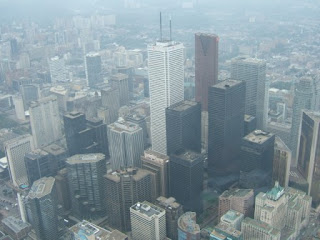
4. Singapore or where?

5. Singapore or where?
Answers:
- Times Square New York
- Sears Center Toronto
- Bangkok
- Toronto
- Hong Kong
